QS-210
Where to buy
Price history
Overview
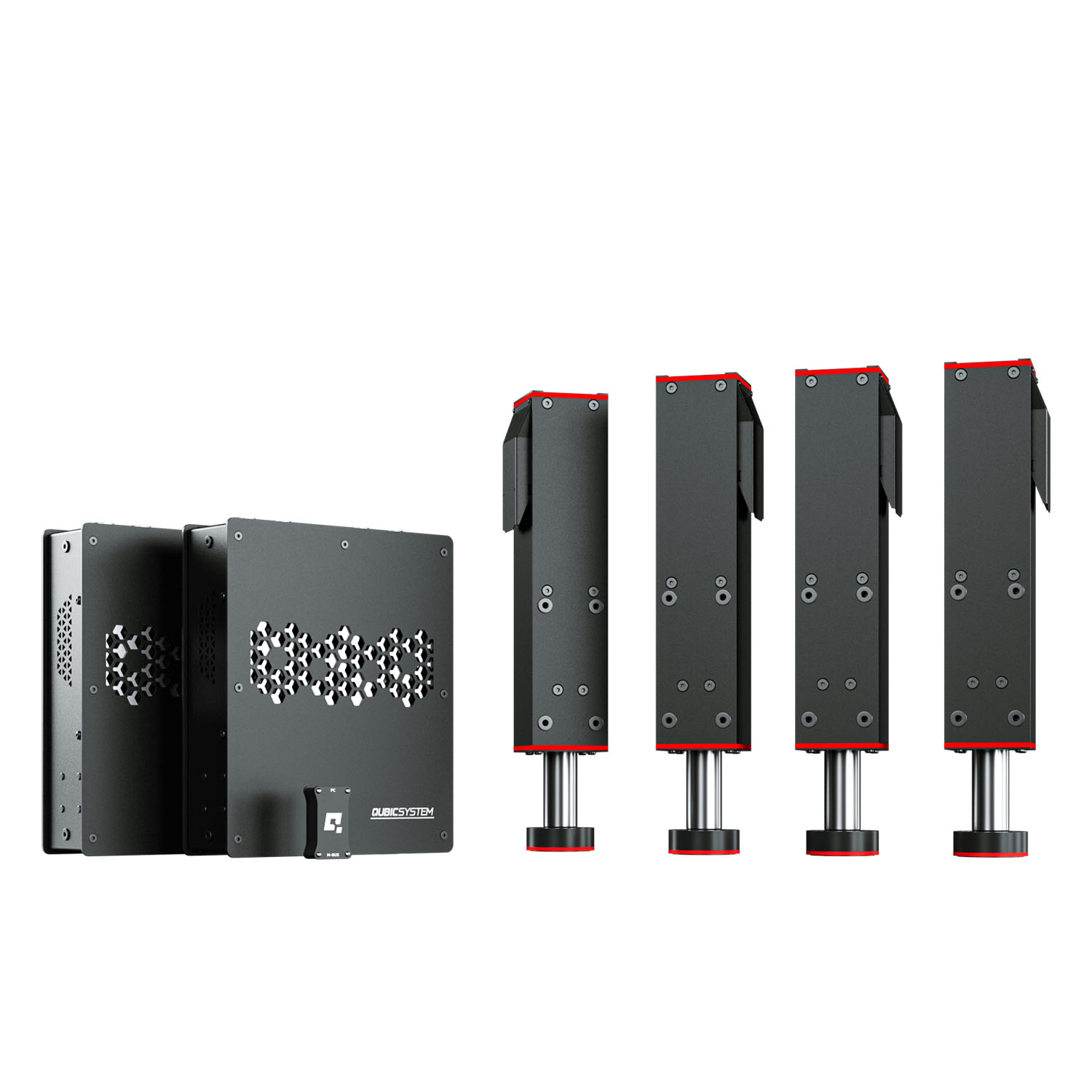
The QS-210 3DoF motion system is designed as a more compact iteration of the Qubic System QS-220 industrial-grade linear actuators. This 3DoF motion set is linear, efficient, easy to connect, and requires no maintenance. The motion system shares the same features as the linear actuators utilized in Qubic System motion cockpits, particularly the attributes of low latency time and real-time vibrations. Tailored for dedicated sim racers and drivers, the QS-210 motion system includes additional sets of brackets that enable racers to install actuators in the most popular aluminum profile based cockpits available on the global market. ASK YOUR LOCAL DISTRIBUTOR - about lead time. If there is no distributor in your country or the product is out of stock, please contact us directly.
Specifications
- Weight
- 30 kg | 66.1 lb
- Architecture
- 2 / 2.5 / 3 DOF
- Max payload
- 250 kg | 551.2 lb
- Total length
- 10.6 cm | 4.17 in
- Total width
- 9.2 cm | 3.62 in
- Total height
- 45.7-51.7 cm | 17.99-20.35 in
- Realism
- Simracing aims to replicate real-world racing closely. Low latency ensures the virtual car responds in real-time, enhancing immersion by mimicking a real car’s responsiveness.
- Precise control
- Racing games require precise control over steering, braking, and acceleration. Low latency ensures minimal delay in translating your inputs to the game, enabling accurate and responsive control, especially in fast-paced races.
- Safety
- In simracing, accidents can happen. Low latency allows quick reactions to track changes, reducing the risk of collisions or losing control.
- Competitive advantage
- Milliseconds matter in simracing competitions. Low-latency setups give drivers a competitive edge by enabling faster reactions and split-second decisions.
- Real time feedback
- Low latency provides immediate feedback from input devices, helping drivers understand their vehicle’s behavior and make adjustments during races.
- Consistency
- Minimal delay maintains consistent lap times and performance, allowing simracers to execute precise maneuvers consistently.
- Enhanced experience
- Low latency complements high-quality hardware and software, ensuring a seamless interface and an enjoyable racing experience.
- Training and skill development
- Simracing serves as a training tool for real-world racing. Low latency lets drivers practice and refine skills in a realistic virtual environment, translating into improved on-track performance.